Build strength, speed, and balance through functional futbol-specific training designed for youth players from HOME or a GYM— and guided by parents who care.

Get unlimited access to our online performance and technical classes in different categories. 

Is Your Player Missing the Athletic Edge?

Your child might train hard but still gets pushed off the ball or loses balance in challenges.

They may be skilled with the ball but lack the strength and control that separates good from elite players.

Without the right athletic foundation, all the drills in the world can’t unlock true performance.

You’re Not Alone

Most youth players skip the foundational athletic work. I’ve seen hundreds of kids struggling with posture, coordination, and strength — not because they don’t train, but because no one teaches them how to train like athletes. That’s why this program exists — to help parents and players build the right habits early.

Imagine Your Player Just 6-8 Weeks From Now

💪🏼 Stronger & More Confident — Wins 1v1s and stays balanced under pressure.

💨 Faster & More Explosive — Accelerates, reacts, and moves with control.

🩻 Resilient & Injury-Free — Gains stability and coordination that protects joints.

From Soft to Athletic

The step-by-step course that builds athleticism every youth player deserves — blending science-based strength, stability, and movement drills parents can guide at home or on the field.

What You’ll Learn

  • Train the body like an athlete, not just a soccer player.
  • Build real lower-body and core strength for power and speed.
  • Improve coordination and posture to perform with control.

Who It’s For:

Athletes ages 8–14 and parents who want to guide their child’s growth the right way — safely, efficiently, and effectively.

Inside the Course

You can’t build soccer skills on a weak base. Before your child can run faster, strike harder, or move with confidence, they need solid foundations.

  • Lesson 1.1

    • Why kids who only play soccer miss out on critical athletic skills

    • The dangers of “early specialization” and how functional training keeps your child healthy

  • Lesson 1.2

    • How to spot good vs. poor form

    • Why posture, alignment, and breathing matter more than reps

    • Simple cues you can use as a parent (e.g., “chest tall,” “knees out,” “hips back”)

  • Lesson 1.3

    • Lower body power: glutes, hamstrings, quads

    • Core stability: the “engine” behind every movement

    • Why even upper body strength matters (shielding, balance, confidence in duels)

Every movement in soccer comes from the body’s ability to coordinate strength, balance, and control. Training these systems directly improves touches, passing, dribbling, and striking.

  • Lesson 2.1 –

    • How balance and stability translate to sharper ball control

  • Lesson 2.2

    • How kids “wire” new skills through repetition

    • Why variety and play in training create better, more adaptable players

  • Lesson 2.3

    • Examples: lunges improve changes of direction, core training = stronger shots

    • At-home drills parents can do with their kids (no fancy equipment needed)

To stand out, kids need more than ball skills. They need the athletic base to be faster, stronger, and more resilient than the competition.

    • Skaters
    • Bounds
    • Single-leg stability exercises

      Lesson 3.1 
      • Why strength is misunderstood in youth sports
      • How strength improves:
        • Balance
        • Posture
        • Sprinting mechanics
        • Shielding ability
        • Shooting power
      • Why bodyweight exercises are ideal for young athletes
      • How the muscles and nervous system learn to work together
      • The connection between physical capability and confidence


      Lesson 3.2
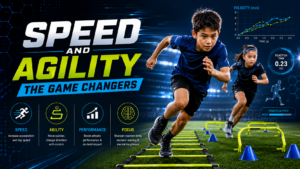
       

      • Why football speed is more than straight-line sprinting
      • The importance of:
        • Acceleration
        • Deceleration
        • Re-acceleration
        • Reaction
      • Understanding force production:
        • Pushing efficiently into the ground
        • Creating explosive movement
      • What agility really means:
        • Controlled change of direction
        • Lowering the center of gravity
        • Safe deceleration
      • How functional training improves movement efficiency
      • Why balance and stability matter for quick movement


    Lesson 3.3
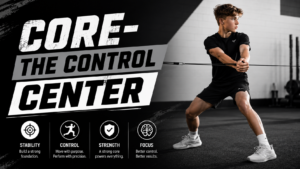
    Main Theme:

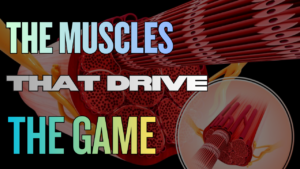
    The core is a system of muscles that stabilizes the body, transfers force, and allows athletes to move with quality and control.

    • The core is more than just the abs
    • Understanding the major core muscle groups:
      • Rectus abdominis
      • Obliques
      • Transverse abdominis
      • Erector spinae
      • Glutes and pelvic stabilizers
      • Diaphragm and breathing muscles
    • Functions of the core:
      • Stability
      • Rotation
      • Posture control
      • Force transfer
    • How the transverse abdominis acts like a natural belt
    • Why back muscles help posture and athletic positioning
    • The role of the glutes in power and balance
    • How breathing muscles improve efficiency and relaxation during play

    Key Performance Connections:

    • Cleaner passing
    • More controlled shooting
    • Better balance during turns
    • More efficient movement patterns


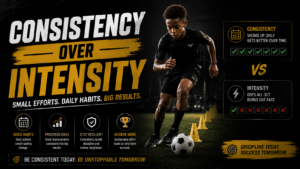
Consistency beats intensity. You’ll learn how to support your child without overtraining or burning them out.

  • Lesson 4.1

    • Kids should not train like adults
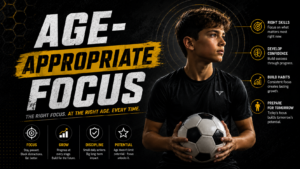
    • Different age groups need different priorities
    • Athletic development must progress gradually
    • Fun + movement quality come first

    Lesson 4.2 –
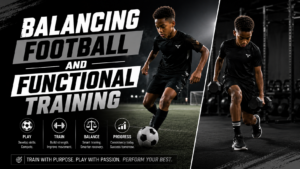
    • Functional training enhances football
    • Short sessions are highly effective
    • Avoid overtraining and burnout
    • Recovery matters

    Lesson 4.3 –

    • Small improvements compound over time
    • Nervous system adaptation matters
    • Consistency builds confidence and efficiency
    • Development takes patience

    Lesson 4.4 –
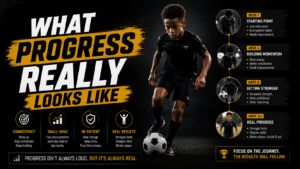
    • Better posture and balance matter
    • Confidence and control are development signs
    • Reduced fatigue = improved efficiency
    • Athletic growth is often subtle at first

    Lesson 4.5
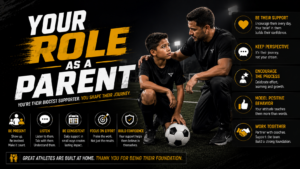
    • Encourage effort, not pressure
    • Keep training fun and safe
    • Long-term mindset matters
    • Parents help build confidence

Lesson 5.1
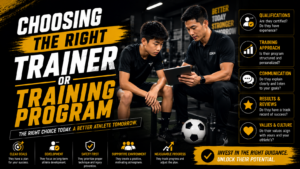
A quality training program focuses on movement fundamentals, long-term development, and safe progression—not just intense workouts or flashy drills.

  • Why choosing the right trainer matters for long-term development
  • What parents should prioritize in a program:
    • Movement quality
    • Proper progression
    • Strength built safely
    • Balance and coordination development
  • Why flashy drills and excessive intensity can be misleading
  • The importance of:
    • Proper posture
    • Technique correction
    • Alignment and body control
  • Understanding gradual athletic development
  • Why training should challenge—not overwhelm—young athletes
  • Creating a positive environment.

Signs of a Quality Program:

  • Coaches correct movement and form
  • Training is age-appropriate
  • Focus on long-term development
  • Safe progression and proper workload management
  • Emphasis on body control and athletic foundations

Lesson 5.2
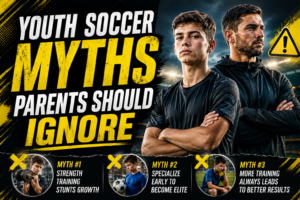
Many common beliefs in youth sports are outdated or misleading. Understanding modern sports science helps parents make better decisions.

  • Myth #1:
    “Strength training stunts growth.”
    • Modern research shows properly supervised strength training is safe
    • Benefits include:
      • Improved coordination
      • Increased bone density
      • Reduced injury risk
      • Better athletic performance
  • Myth #2:
    “Kids should only focus on soccer to become elite players.”
    • Multi-sport participation helps:
      • Coordination
      • Balance
      • Overall athletic development
    • Early specialization may increase:
      • Burnout
      • Overuse injuries
      • Mental fatigue
  • Myth #3:
    “More training always means better results.”
    • Recovery and variety are essential
    • Overtraining may lead to:
      • Fatigue
      • Injury
      • Loss of motivation
    • Smart development balances:
      • Soccer
      • Athletic training
      • Recovery
      • Free play
WhatsApp-Image-2026-03-02-at-12.39.30

Giulia Franco

Born in Santos, Brazil, where she began playing futsal for Santos at a young age, developing her technical skills and passion for the game early on.

She continued her soccer career in the United States, competing at both the NAIA and NCAA Division I levels, including at the University of Louisiana Monroe, where her team became Sun Belt Conference regular season champions. Giulia has also competed in the USL W League and is now playing for Fort Lauderdale United FC.

She graduated with a degree in Kinesiology, concentrating in Exercise Science, which gives her a strong understanding of how athletes train, develop, and maintain long-term health and performance.

Alex da Silva (1)

Alex da Silva

Born in Brazil, ACE Certified Sports Performance trainer. Joined a professional team (Atletico de Alagoinhas) in 2004 while in college (Physical Education), Played men’s regional futsal in 2005 before he came to the US. Played USL 2 in the US in 2019. Private Soccer Trainer since 2016. Certified in Soccer Video Analysis.

Real athletes. Real Transformations

Why Does this program Stands Out

  • ⚙️ Sports-Science Based: Functional training adapted for youth bodies.
  • 👨‍👩‍👧 Parent-Guided: You’ll know exactly what to do and how to correct form.
  • 🧠 Skill-Transfer Focused: Every drill improves performance on the ball — not just fitness.

Enroll Before May 30th to Get This Bonus!

Try It 100% Risk-Free

If you don’t notice progress in posture, control, or movement quality within 4 weeks, simply email us — we’ll refund your purchase. No questions asked.

Questions? We’ve Got You Covered

Yes — all of our drills are specifically designed to be done at home or at a small gym room.

You don’t need a big field or facility. Most sessions can be completed in small spaces like a living room, backyard, garage, hotel or home gym, making it easy to stay consistent with training no matter your setup.


No — your child can follow our programs with or without equipment.

Every workout video comes with two versions:

  • Home Gym Version: Uses simple, basic equipment like step, bands, or a ball
  • Bodyweight Version: No equipment needed — just space to move

This gives your family flexibility to train anywhere, while still building strength, coordination, and athleticism the right way.

Yes — every module includes clear video demonstrations and step-by-step explanations.

We show exactly how each movement should look, so parents and athletes can confidently follow along and apply it the right way.

Completely — our training is built with young athletes in mind. Every exercise prioritizes movement quality over load, helping kids develop proper technique, coordination, and body control before adding intensity. This approach keeps training safe while building a strong athletic foundation

While many parents notice their child becoming stronger, more athletic, and more coordinated within the first 6-8 weeks, your enrollment includes lifetime access to the platform. That means your child can continue progressing with a growing library of functional strength and conditioning workouts, along with ball skills sessions designed to support long-term athletic development and football performance.

Don’t Wait Another Season

Every month you delay, the athletic gap between your child and stronger players widens. Give them the foundation that builds confidence, strength, and performance.